Artificial Intelligence and the Next Phase of the Secular Bull Market

At Emerald Asset Management, much of our day-to-day portfolio work involves distinguishing durable, long-term investment themes from shorter-term market narratives. Artificial intelligence increasingly falls into the former category. While the technology itself often dominates headlines, the more relevant question for investors is how AI is being built, adopted, and ultimately translated into economic value over time.
Over the past several years, AI has evolved from a conceptual innovation into a meaningful driver of capital spending, market leadership, and sector performance. That evolution has not been uniform, nor has it been linear. As with most transformational technologies, progress has occurred in phases, with different parts of the market benefiting at different times. Understanding where we are in that progression matters far more than reacting to any single headline or short-term market move.
To date, much of the market’s AI-related performance has been driven by what can best be described as the infrastructure phase. This includes:
semiconductors
data centers
networking equipment
cloud computing platforms
substantial energy resources required to support them
Before artificial intelligence can meaningfully improve productivity or decision making, the physical and digital foundation must exist. Over the last several years, companies across the technology, industrial, and energy landscape have committed significant capital toward rapidly expanding that foundation.
As this infrastructure has expanded, we have begun to see the application phase take shape. AI is increasingly embedded into enterprise software, analytics, automation, and decision-support tools. These applications are no longer theoretical. They are already being deployed in a growing number of areas, including logistics, customer service, financial analysis, manufacturing, healthcare, and cybersecurity. This helps explain why the economic impact of AI is gradually broadening beyond a narrow group of hardware-focused companies and into a wider range of industries.
The buzz we have been hearing in financial and investment circles is that 2026 could be the “year of the agents.” In practical terms, agents are AI systems designed not just to analyze information, but to act on it, executing tasks, coordinating workflows, and making decisions with limited human intervention. Importantly, this discussion is emerging only after several years of heavy investment in AI infrastructure. Semiconductors, data centers, networking equipment, and related hardware have led the way, and we would expect many of those areas to continue to play an important role as AI adoption progresses. As always, the pace of this transition will depend on real-world implementation, economics, and return on investment.
However, we’ve seen this before. The build-out of the internet in the late 1990s was accompanied by enormous investment in hardware, networking, and infrastructure, followed by a well-documented bust. While the excesses were painful, the underlying technology ultimately reshaped the economy. In many cases, the most durable and economically meaningful benefits became evident only after the initial cycle had run its course. The lesson is not that innovation fails, but that markets often move faster than adoption in the early stages.
If artificial intelligence follows a similar path, leadership may gradually broaden beyond infrastructure and hardware into software, applications, and the industries that ultimately put the technology to work. Importantly, this type of broadening does not require early leaders to stop performing. In past cycles, infrastructure- and hardware-oriented companies often continued to benefit even as new areas emerged. As the concept of AI agents unfolds, we are increasingly focused on identifying software opportunities, alongside select areas of the industrial sector, where AI-driven automation, efficiency gains, and productivity improvements may translate into tangible economic outcomes over time.
From a broader market perspective, we believe artificial intelligence is likely to remain a key driver of the current secular bull market. That does not mean returns will be smooth, leadership will remain static, or volatility will be absent. Transformational technologies tend to progress in stages, often accompanied by periods of enthusiasm, consolidation, and rotation beneath the surface. Recognizing those shifts, and positioning portfolios accordingly, is central to our long-term investment discipline.
It is also important to acknowledge the constraints that face the progress of AI. Artificial intelligence is energy-intensive, capital-intensive, and dependent on complex global supply chains. These realities tend to favor companies with scale, access to capital, and pricing power, and they help explain why progress occurs in phases rather than all at once. They also reinforce the importance of diversification and risk management as AI adoption continues to evolve.
At Emerald Asset Management, we view artificial intelligence as a structural growth driver with the potential to influence markets and economies for many years. That does not mean every company associated with AI will succeed, nor does it eliminate periods of volatility along the way. As with previous transformational technologies, the path is unlikely to be straight. For long-term investors, that reality argues for patience, perspective, and a focus on how enduring trends ultimately translate into real economic value.
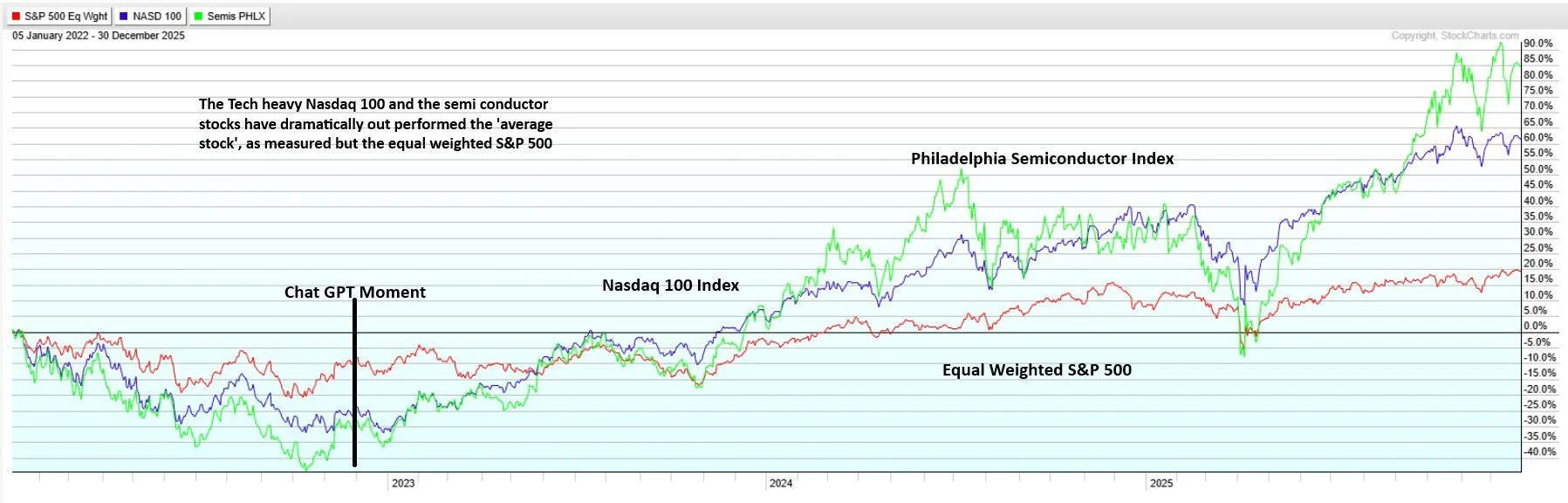
Five-year total return comparison of the NASDAQ-100, Philadelphia Semiconductor Index, and S&P 500 Equal Weight Index, with November 30, 2022 marked as the public release of ChatGPT. Since that inflection point, performance has been led by semiconductors, followed by large-cap technology, while the equal-weighted index— representing the average stock—has trailed, highlighting both concentration and the role of AI-related infrastructure in recent market leadership.
Sources: Gartner Research & Commentary, McKinsey & Company, IEAE, Financial Times ‘ Reuters, Investopedia and StockCharts.com
Emerald Asset Management is an independent, boutique Registered Investment Advisory firm based in Rocky Mount, NC, serving successful executives, business owners, and high-net-worth individuals across Raleigh, Durham, and Chapel Hill. As a fiduciary-led firm with over 30 years of experience, Emerald provides research-driven investment management and strategic financial planning. The firm specializes in individually managed stock and bond portfolios, alternative investments, and risk management strategies. With a disciplined approach and a commitment to clarity, Emerald helps clients navigate complex financial decisions with confidence. They can be reached at (252) 443-7616 or on the web at www.emeraldam.com.
This material has been edited with the assistance of artificial intelligence tools. The information presented is based on sources believed to be reliable and accurate at the time of publication. This material is for educational purposes only and does not necessarily reflect the views of the author, presenter, or affiliated organizations. It should not be construed as investment, tax, legal, or other professional advice. Always consult a qualified professional regarding you
Emerald Asset Management is an investment adviser registered with the U.S. Securities and Exchange Commission. Registration does not imply a certain level of skill or training. More information about Emerald Asset Management's investment advisory services can be found in its Form ADV Part 2 and/or Form CRS, which is available upon request.